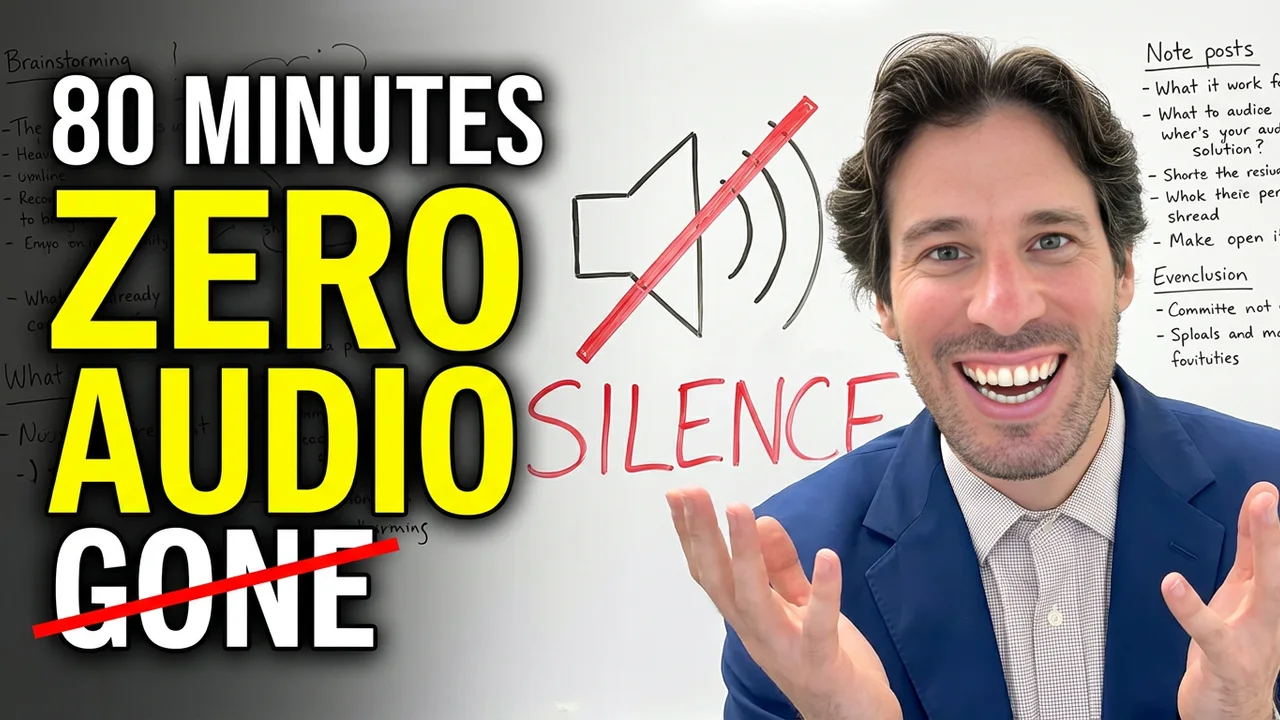
What happened when my 80-minute live stream recorded in silence?
The audio was simply gone. I ran a pre-stream test, the test passed, and then 80 minutes of live content — two full whiteboards, 15 years of personal development compressed into a single session — came back as silence. No voice. No crowd energy. Nothing. I deleted the file. It is off the internet and will never be seen again. That is the reality of Day 308 of building in public.
The session was not a throwaway. I described it at the time as one of the best live streams I had ever done. I was connecting ideas about silence, ideation, and what it takes to think clearly — material drawn from what I estimate is well into the six figures spent across coaches, events, flights, and probably over a thousand books read across the last 20 years.
At [0:52] I said: "I just absolutely slayed. And then it did not record the audio" — and that gap between the high of the performance and the cold fact of the empty file is exactly where radical acceptance either holds or breaks.
What is radical acceptance and why does it matter for builders?
Radical acceptance is the practice of fully acknowledging a situation as it is, without resistance, negotiation, or the need to assign blame. It is a concept rooted in dialectical behavior therapy, though I am using it here in a practical, not clinical, sense.
The framing I kept returning to on stream was simple: "This is now the circumstance. This is the reality in which I now live." That is not resignation. It is the starting line. You cannot rebuild from a situation you are still arguing with.
The audio failure is one example. But I also named 3 major builds — each costing months of work and thousands of dollars — that I scrapped entirely. Real estate deals that fell through at the last moment. A broker-owner career of 17 years now in transition. The pattern is the same every time: the circumstance arrives, and the only productive move is to name it clearly and keep going.
How does the 90-10 rule explain who wins in an AI-saturated world?
I have been pushing a version of the Pareto principle on stream for a while, but I think the standard 80-20 framing undersells the actual concentration. My read is that it is 90-10 now, not 80-20.
You might also like


The logic runs like this: 10% of baseball players hit 90% of the home runs. 10% of the actions at the gym produce 90% of the results. 10% of coaches win 90% of the Super Bowls. The world is too vast for 20% to be leading everything — the gap is wider than that.
Right now, the 10% who are going to win are the creators. Not creators with a capital C and a brand deal. Creators lowercase c — people who make things, ask questions, design features, build communities, write, code, landscape, anything that produces rather than consumes.
The 90% are consuming. More content, more drama, more podcasts, more AI slop. That need, as I put it on stream, is impossible to meet. The personal development loop — consume, consume, consume — never closes. The only exit is to start making something.
What does authentic integrity look like when AI can fake everything?
Authenticity and integrity are not soft concepts anymore. In a world of deepfakes, voice cloning, and AI-generated video so convincing that I personally believed a dog video was real before someone pointed out it was generated — these are the only durable differentiators.
Integrity, as I defined it on stream, is alignment: thoughts, words, and actions pointing in the same direction. The test is simple. If you met someone in person after following them online, would they be the same person? I have heard from enough people that the answer is often no — the energy that reads as engaging on Instagram collapses the moment the camera turns off.
The YouTube community membership content policies set a floor for what platforms will tolerate, but they cannot enforce the internal alignment that makes a creator worth following over years. That comes from the person, not the platform.
I went live for 80 minutes with no audience reward — no viral clip, no monetization, no polished output. The audio did not even record. That is as close to a pure integrity test as building in public gets.
How does the 1% framework replace revenue as a success metric?
I have made $0 in 28 days. I want to say that plainly, because I saw a creator on YouTube claiming $28,000 in 22 days of vibe coding. Charles cited that figure directly from the creator's title — I do not know his backstory, whether he had a product before, or whether the number is accurate. I just saw it and noted it.
My metric is different. It is 1% better every single day. Here is what that looks like in practice:
- 1% more views on the next video than the last.
- 1% more watch time on the next live stream.
- 1% better community experience on iCharles — one feature, one fix, one improvement.
- 1% more honest in what I put on camera.
- 1% less resistance when something breaks.
That last one is the hardest. The audio failure cost me a week. I cannot progress that content until I re-record it next Friday. But the compounding on 1% daily improvement over 308 days is the actual asset — not any single session.
What questions do builders ask about recovering from public failure?
What should I do immediately after a live stream fails to record audio? Run the test you should have run before going live, then run it again. I did a pre-stream audio test and the stream still failed — so the test was not sufficient. After the failure, I confirmed the file was silent, deleted it, and scheduled a re-record for the following Friday. The re-record will go to iCharles.com community members, not the public feed.
Is it worth re-recording content that was lost to a technical failure? Yes, with one caveat: the second version will be different, not worse. A re-record is not a copy — it is an iteration. I expect next Friday's session to be a better version of what I lost, because I now know what the core argument is. The loss forced me to distill it.
How do I stay credible when I am publicly failing and earning nothing? By saying so. I have earned $0 in 28 days. Three major builds are gone. A 17-year career is in transition. Naming those facts clearly is the credibility. The alternative — projecting a success arc that does not exist — is exactly the integrity failure I described on stream.
What is the difference between being content and being happy? I drew this distinction on stream: happiness is a state, a feeling, and it is impossible to hold. You pass through happiness. Being content is a different posture — it is the ability to sit with the current circumstance, including its failures, without needing it to be something else. Radical acceptance and contentment are the same muscle.
Why are creators going to outperform consumers in an AI-dominated environment? Because AI makes consumption infinite and nearly free. There is no floor on how much content can be generated and served. The only scarce resource left is genuine creation — the person who makes something that did not exist before, who asks a question nobody scripted, who ships a feature a community member requested. A community member suggested a swipe-down post refresh on mobile. That is creation. AI does not originate that.
0 Comments
Log in to comment
Not a member yet? Join the community
Pick a meme
KlipyHave a great take?
Drop your email — we'll send a magic link so you can post it. No password.
Not a member of the community? Join today.
Join the community →