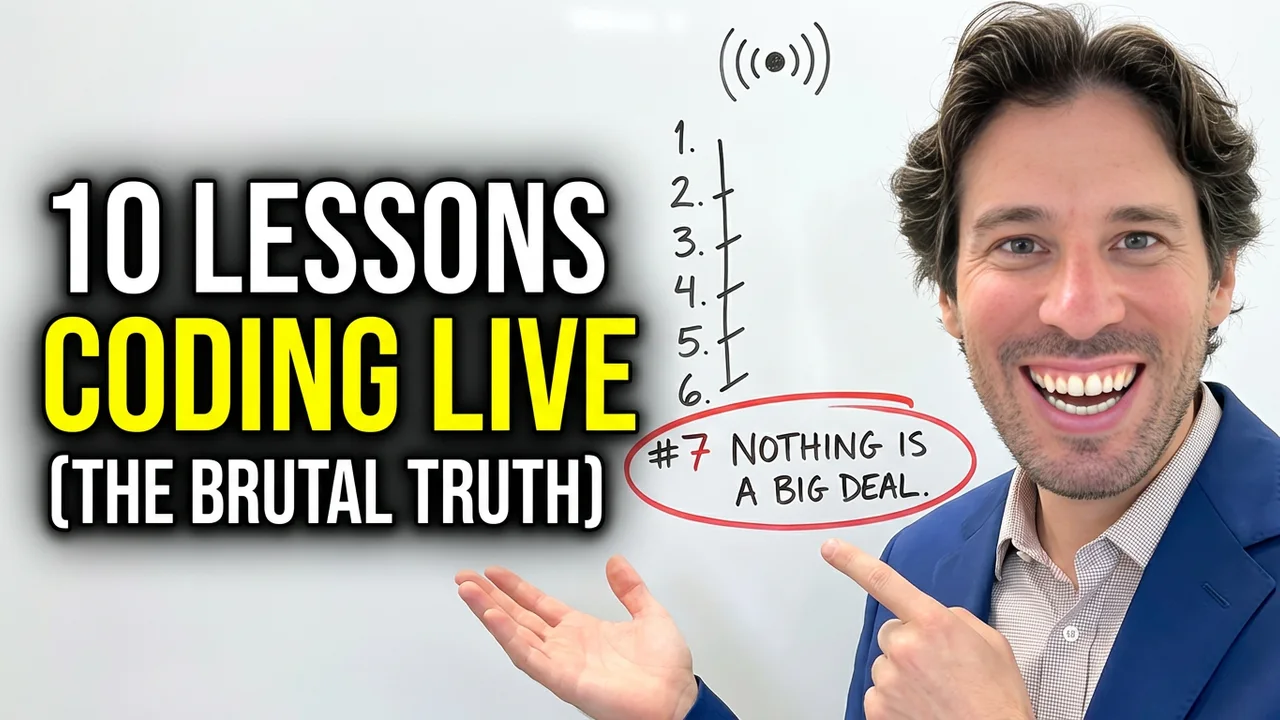
What does 308 days of live vibe-coding actually teach you?
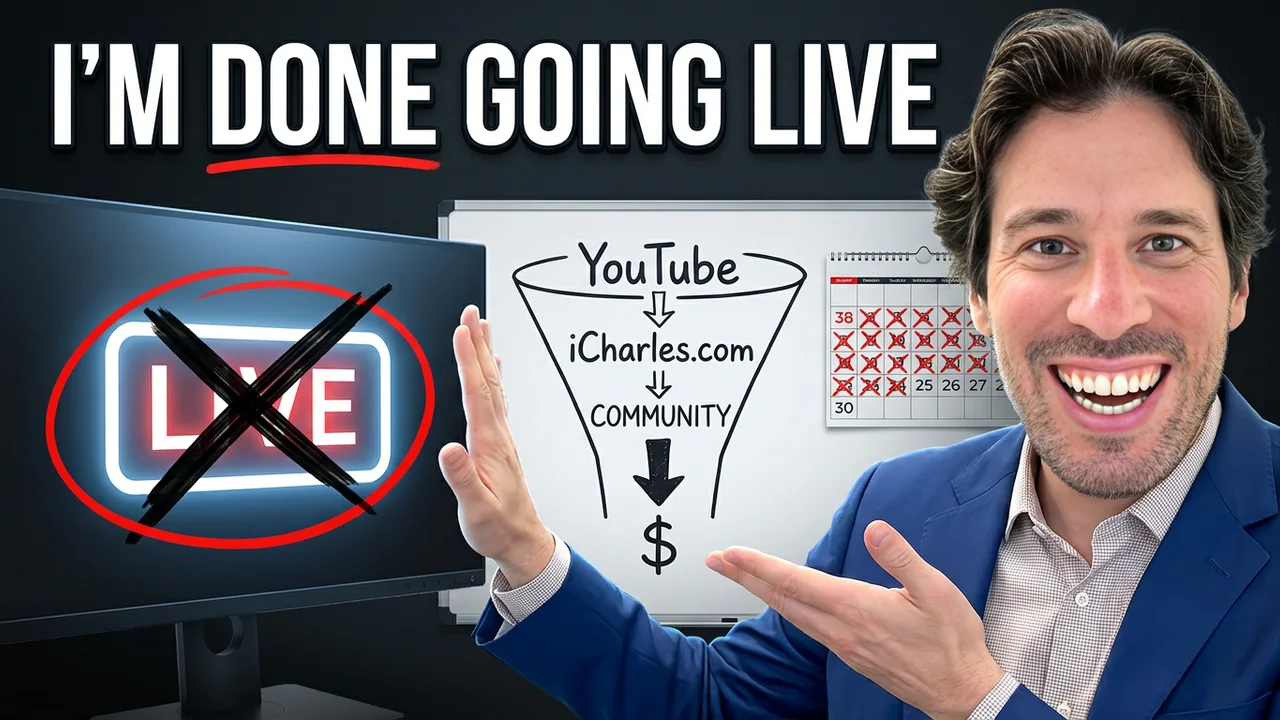
After 308 days of live vibe-coding, the clearest lessons are these: sound quality beats camera quality, consistency beats perfection, and vulnerability builds more trust than polish ever will. Vibe coding is the practice of building software live on camera — every compile error, every design pivot, every wrong turn — in front of a real audience in real time. I came to this from 17 years in real estate, plus a stint in finance, door-to-door sales, caddying, and waiting tables. The learning curve is unlike anything I have tackled before. The intricacies surprised me completely.
The core tension is simple: you are simultaneously a builder, a broadcaster, and a host. None of those roles fully prepares you for the other two. What follows are the 10 lessons I mapped out on the whiteboard this week. They are drawn from the good sessions, the bad ones, and the one day at Day 26 that nearly broke me.
What are the 10 lessons from 308 days of live vibe-coding?
- Showing up is the only variable you control — watch time and views are YouTube's call, not yours; consistency beats chasing the number.
- Manufacture your energy before you go live — use a "doorway reframe" to flip the switch; you can't wait to feel good first.
- Routine is the infrastructure — without it, your mood is just weather, and the chat is a mirror of it.
- Understand the architecture of chat culture — anonymity invites toxicity; depersonalize it, don't take it personally.
- Know the room you walked into — humor that lands in one place lands badly in another; read your audience.
- Have a business worldview before going live — the chat can smell a bluff; know where you're going and how you make money.
- Sell inspiration, not just a roadmap — what keeps people coming back is the vision, not a recurring-revenue number.
- Sound quality beats camera quality — a good mic with a messy background outperforms a 4K camera with bad audio every time. A few solid options at different price points:
- Blue Snowball iCE (~$50) — plug-and-play USB, immediate step up from built-in audio
- Samson Q2U (~$70) — USB and XLR on the same mic; grows with you if you upgrade later
- Audio-Technica ATR2100x (~$80) — same USB/XLR flexibility, slightly warmer pickup
- Blue Yeti (~$130) — the streamer standard; cardioid mode rejects room noise well; what I would buy first if starting today
- Vulnerability builds more trust than polish — showing the wrong turns and failures is the content strategy.
- "Nothing is a big deal" — the mantra that keeps a live builder steady when a session, or a Day 26, nearly breaks you.
Why do good and bad streaming days feel completely random?
At [1:52] I said: "Sometimes you're on fire and there's no one there. And sometimes everyone's there and you're not on fire" — and that asymmetry is the first thing every live builder needs to accept.
I went live last Thursday thinking the session was terrible. YouTube disagreed and served it to 700 people. I have had sessions I was proud of that went nowhere. The watch time and the views are entirely in YouTube's hands, not mine. The only variable I actually control is whether I show up. That realization is both humbling and, oddly, freeing. It removes the pressure of performing for a number and replaces it with the simpler discipline of consistency.
How does low energy on stream spiral?
This morning I spent about 30 minutes doom-scrolling before going live. It tanked my mood, and the session showed it. Low watch time, low comments, low engagement — the audience felt what I felt. The chat is a mirror.
Tony Robbins calls the fix the "doorway reframe." Before walking through a door, you flip a switch. High energy on. I am not doing push-ups in a rented office space the way Matt Miller does on his stream. But the principle is the same. You cannot wait to feel good before going live. You manufacture the state first, then walk in. Routine is the infrastructure that makes that possible. Without it, mood is just weather.
You might also like

What does a toxic chat comment actually mean for a live builder?
People enter a live chat carrying the full weight of internet anonymity. There are no repercussions behind a fake username and a fake account. I am from New York City. I am sarcastic. That humor lands perfectly in the Northeast and lands badly almost everywhere else on the planet. I had to learn that the hard way, live, in front of an audience.
When someone walks into the chat and starts throwing insults, the instinct — especially for someone new to the internet, which I essentially am — is to take it personally. The reframe I had to build is that the chat system is designed for exactly that behavior. Understanding the architecture of the internet's comment culture is not cynicism. It is just accurate. You have to know the room you walked into.
Should a live vibe-coder have a business worldview before going live?
Yes, and the chat will expose you fast if you do not. The community can smell a bluff. The question I get constantly is "What are you building?" — and I have a whole video unpacking why that question, as reflexively as it gets asked, is worth interrogating.
What I am building is not a SaaS product with a monthly recurring revenue number I can flash on screen. I am building a community of like-minded people — builders, designers, data architects, back-end developers, even the good-faith security researchers who were stress-testing my setup and forced me to tighten it. The business basics matter: where are you going, what is the journey, how do you make money? But the deeper answer is that you have to give the audience inspiration, not just a product roadmap. That is what keeps people coming back.
Does sound quality really matter more than camera quality for live coding streams?
In my experience, yes — and I have watched enough channels to feel confident in this. I know creators with hundreds of thousands of subscribers who stream into their phone with a messy background. Their camera is not impressive. Their sound is excellent. They are entertaining. They have a microphone. That combination beats a 4K camera with mediocre audio every single time.
The YouTube live streaming best practices confirm that audio clarity is a primary driver of viewer retention. If I were starting over with zero budget, I would turn on my phone and start creating — but I would find a microphone first. The barrier to entry is lower than most people think, and the single highest-leverage investment is in what the audience hears, not what they see.
A few solid options at different price points:
- Blue Snowball iCE (~$50) — plug-and-play USB, works on any laptop, immediately noticeable step up from built-in audio
- Samson Q2U (~$70) — USB and XLR outputs on the same mic; if you upgrade to an audio interface later, you keep the mic
- Audio-Technica ATR2100x (~$80) — same USB/XLR flexibility, slightly warmer pickup character
- Blue Yeti (~$130) — the streamer standard; cardioid mode rejects room noise well; what I would buy first if starting today
What is the "nothing is a big deal" mantra and where did it come from?
At Day 26, someone who had been active and trusted in my community did something that was genuinely not right. I had trusted them. It was a hard crash-out — the last 20 minutes of that session were rough. And I had to find a frame that let me keep showing up the next day.
The mantra I landed on: nothing is a big deal. Matt Miller hit a DDoS attack mid-stream. He set up Cloudflare DDoS protection live on camera, then turned the whole incident into a marketing video the next day. A crisis became content. That is the posture. Something bad happens. You name it, you handle it live if you can, and you move. The audience respects the recovery more than they would have respected a clean session.
How does vulnerability work as a content strategy for builders in public?
We are in a world where pressing a button turns on a phone, opening an app takes a second, and AI can produce a blog post or a business plan on demand. Everything around the audience feels frictionless and polished. That is precisely why being honest about what is hard, what failed, and what you do not know yet is the differentiator.
I am not Matt Miller. I am not the other vibe-coders. I have a wild past. Seventeen years in real estate, a career pivot most people would not attempt, and a Northeast personality I am still calibrating for a global audience. The Google E-E-A-T framework rewards first-hand experience and demonstrated trustworthiness for exactly this reason: in a landscape full of generated content, the person who shows their actual work — including the ugly parts — earns the trust that polished content cannot.
My niche is connecting dots that do not seem connected. Old AI news, current world events, what it means for builders who own their own stack — a Mac Studio, their own server, their own data. That is where I come in. I will never have 100,000 people watching live. I am a dark horse. But the people who show up are showing up for something real.
0 Comments
Log in to comment
Not a member yet? Join the community
Pick a meme
KlipyHave a great take?
Drop your email — we'll send a magic link so you can post it. No password.
Not a member of the community? Join today.
Join the community →