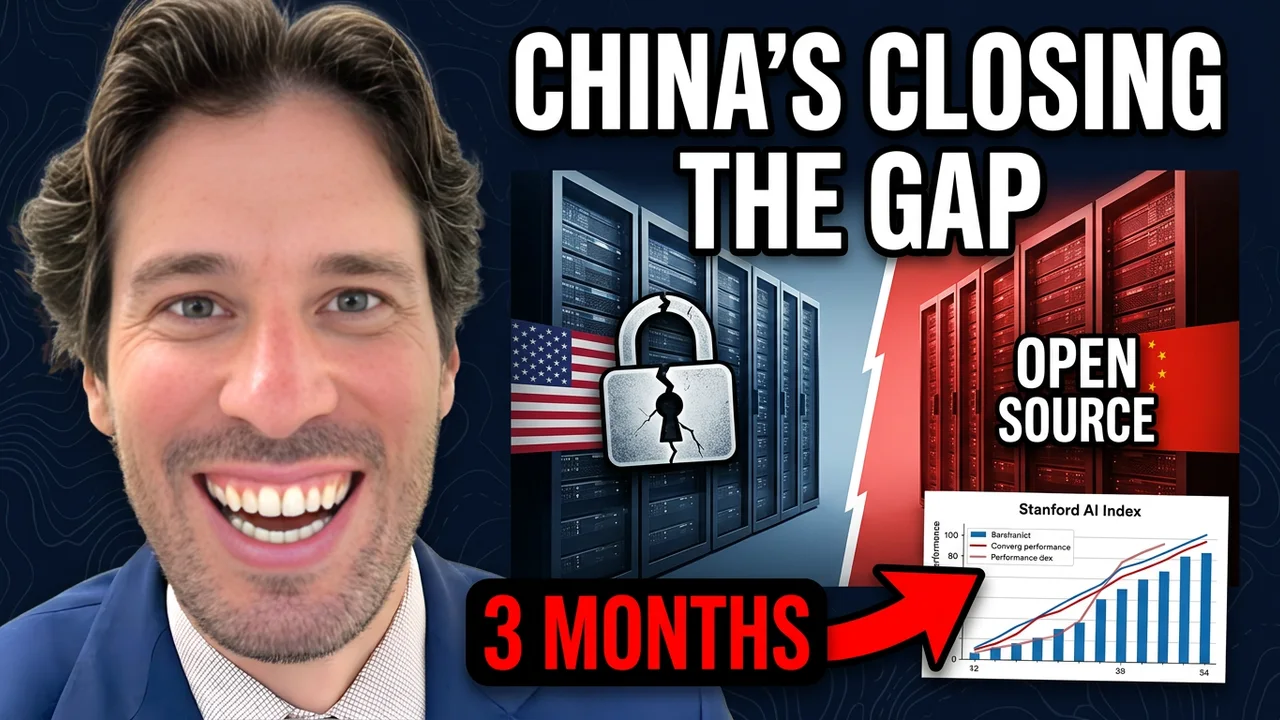
Chinese open-weight models have closed the performance gap with US closed-source systems from roughly 12 months down to about 3 months — a compression that, in my read, changes the enterprise adoption calculus entirely. The Stanford AI Index and Epoch AI data support that conclusion: Chinese models are now competitive on the benchmarks enterprise buyers actually care about.
How does China's shrinking AI lag affect enterprise adoption?
Chinese open-weight models have closed the performance gap with US closed-source systems from roughly 12 months down to about 3 months. The Stanford AI Index and Epoch AI show Chinese models are now competitive on the STEM and programming benchmarks that enterprise buyers actually use to evaluate models.
When the lag is that narrow, price becomes the primary differentiator. That shift changes the adoption decision in ways the current US market strategy doesn't fully account for.
Why does the US AI strategy prioritize compute scaling over open-weight models?
My read of the US strategy is that it's a wager on closed-source, multimodal systems built on proprietary training pipelines — the thesis being that sheer compute creates a moat open-weight competitors can't cross.
You might also like




That moat is shrinking by the quarter. If the lag was 12 months two years ago, then 6, then 3, the extrapolation is uncomfortable. At some point the gap becomes noise, and compute cost is the only differentiator left.
What did the US-China AI summit reveal about China's negotiating position?
Reading the summit sequence — a reported Boeing aircraft deal whose figures I couldn't independently verify, Jensen Huang's restaurant appearance, then falling US futures on Friday — one read stands out. The US came to negotiate access and left without a deal.
China signaled that its unreleased models are already competitive enough that it has no need to open its market to US AI systems. China held the stronger negotiating hand.
How does the AI cost gap between US and Chinese models reshape adoption decisions?
My view is that the cost gap is already splitting the market by segment. Routine, high-volume, low-complexity tasks don't require frontier closed-source models — open-weight alternatives are good enough there.
Individual builders on tight budgets and mid-tier companies running templated workflows will route that work to whatever runs cheapest. As open-weight models close the quality gap, the CFO's incentive to defect on routine work accelerates.
Will enterprise companies stay on US closed-source AI or switch to cheaper alternatives?
My expectation is that top enterprise companies in law, healthcare, and finance won't defect on cost. A wrong inference in a clinical or legal context is not a recoverable error, and the risk calculus doesn't change with cheaper pricing.
The financial incentive to stay on closed-source is strong precisely because being second-tier in those domains carries real consequences. Open-weight and Chinese models take the high-volume, low-stakes work; closed-source holds the rest.
| Use case | Likely model choice |
|---|---|
| Complex legal or financial reasoning | Closed-source (Claude, GPT-4 class) |
| Healthcare inference and clinical support | Closed-source |
| Routine CRM tasks, templated emails | Open-weight or Chinese models |
| Mid-tier company general productivity | Hybrid or open-weight |
| Individual builders on tight budgets | Open-weight |
Could a compute architecture breakthrough disrupt the US-China AI scaling race?
I hold this loosely. The expectation is that someone eventually invents a genuine architectural shift that sidesteps the raw-compute requirement entirely. Not an incremental chip improvement, but a fundamental rethink that makes the current scaling war look like a local maximum.
Entrenched data center interests have strong financial incentives to delay that shift. If it comes, the closed-versus-open argument gets reframed entirely.
What are the most pressing questions about the US-China AI divide right now?
Where can I read more about the US-China AI divide on iCharles?
- China's AI Reckoning: Efficiency, Domestic Chips & the Real State of the Race — a deeper look at China's chip strategy and efficiency gains.
- The Economics of Token Exhaustion: Why Flat-Rate AI Subscriptions Collapsed — why cost, not capability, is becoming the deciding factor in model choice.
- The 30-Day Head Start: Trump's Frontier AI Executive Order — how US policy is responding to the closing capability gap.



0 Comments
Log in to comment
Not a member yet? Join the community
Pick a meme
KlipyHave a great take?
Drop your email — we'll send a magic link so you can post it. No password.
Not a member of the community? Join today.
Join the community →