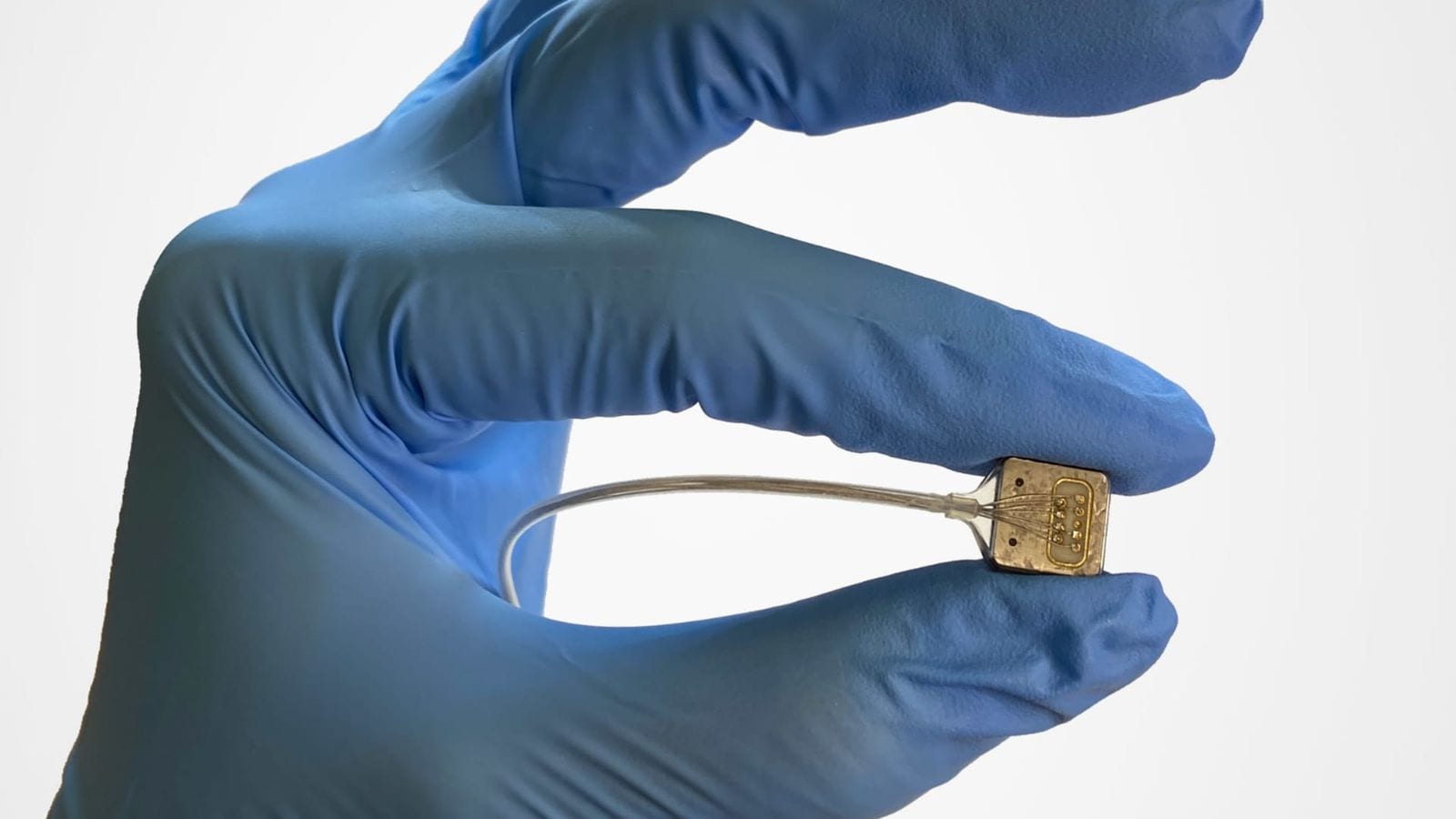
What did Paradromics just do?
Paradromics implanted its Connexus brain-computer interface in the first participant of its FDA-approved clinical study. The patient is a Michigan woman who lost the ability to speak clearly due to motor neuron disease. The surgery took place at University of Michigan Health. She will be monitored for six years.
"For people living with severe motor impairment, the ability to communicate is central to agency, identity, and connection," said founder and CEO Matt Angle, as reported by The Next Web.
What is the Connexus BCI and how does it work?
The Connexus Brain-Computer Interface is a device that records neural activity and translates it into text or synthesized speech on a computer. It does not repair the body. When the patient attempts to speak, the implant captures the brain signals behind that attempt, and software decodes them.
The hardware sits on the surface of the brain. It is roughly the size of a dime. It contains 421 platinum-iridium microwires, each thinner than half a human hair. Those microwires feed into a transceiver implanted in the chest, which beams data wirelessly through the skin.
You might also like




Paradromics claims an industry-leading data rate — the measure of how much neural information the device can pull per second.
How does this implant differ from Paradromics' earlier test?
This is Paradromics' first chronic implant — the kind designed to stay in the brain long-term. It builds on a shorter procedure conducted in 2025, according to CNBC, when the device was placed and then removed during another patient's surgery for epilepsy. That earlier test lasted about 20 minutes. Its purpose was to confirm the system could be safely implanted and record neural activity.
The current implant is a different category entirely. It is meant to remain in place and is the first patient in a formal, long-term FDA study.
Who are Paradromics' competitors in this space?
Paradromics is not alone. The field of speech-decoding BCIs also includes Neuralink, Synchron, and Precision Neuroscience. Neuralink has been the dominant name in public coverage for the past two years. Paradromics' first chronic implant now puts it in direct competition for clinical credibility.
Here's what we know so far: Paradromics is the first of these challengers to complete a chronic implant inside an FDA-approved study specifically targeting speech restoration for motor neuron disease patients.
What are the key milestones in Paradromics' clinical timeline?
| Date | Event |
|---|---|
| May 14, 2025 | First human implant — device placed and removed during epilepsy surgery at University of Michigan |
| 2025 (planned) | Clinical trial for long-term safety and use, pending regulatory clearance |
| 2026 | First chronic implant in FDA-approved study; patient at University of Michigan Health |
| 2026–2032 | Six-year follow-up period for the first chronic study participant |
What caveats should builders and founders keep in mind?
This is one early-feasibility patient. The device has not yet been shown working in a published result. Meaningful data will come over months and years, not days. The study is designed to assess long-term safety and use.
Paradromics also states a broader roadmap that goes beyond medicine. The company has mentioned goals including "direct AI interaction," advanced prosthetics, and "human enhancement." Angle has said building devices that enhance people "doesn't have to be ethically fraught" but "has to be addressed." For now, the study's immediate goal is helping one patient communicate.
Those tracking the intersection of AI and speech technology will want to watch how neural data rates and decoding software evolve as this trial progresses.




0 Comments
Log in to comment
Not a member yet? Join the community
Pick a meme
KlipyHave a great take?
Drop your email — we'll send a magic link so you can post it. No password.
Not a member of the community? Join today.
Join the community →